|
About | Features | Reviews | Community | Screenings | Archives | Home |

August 2007
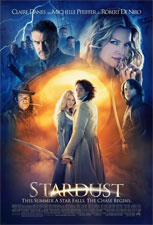
STARDUST
An Interview with Neil Gaiman |
| (August: Main Page * Features * Reviews * Screenings * Teen ) Current Issue * Archive |
|
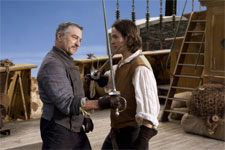
August 6, 2007 Were there any surprises for you when you saw the finished movie? NG: There were, there were lots of surprises. In particular, there were things that I didn't know how well they were going to work, and there were things I had been worried about in reading the script--if not worried, then at least slightly trepidatious. [ed note: "trepidatious" is not a word, it is assumed he means "feeling trepidation"] The guard on the wall was one of them: I read the script and said, "Hang on, you know, he's this old man and been on the wall, and in the book I have young men from the village working in shifts of two who come in and blah-blah-blah. But [here] we just have this one old guy. How is that going to work, and where does he live, and for God's sake, Matthew, where does he go to the toilet? Let's be real about this—people are going to worry." And then I said, "No, nobody is going to worry, it makes complete filmic sense." And I was nervous about the De Niro stuff when I read it in the script I went, "You sure?" And I could absolutely see why they'd written that from the point of view of the theme, in terms of being yourself, of not trying to be the person people try to make you. and it's between what you are on the inside and what you seem on the outside. And it was absolutely great except I read it and said, "This could be so bad. This has potential to go awfully, awfully wrong. And then I said, "Alright, no, it's marvelous!" And astonishingly surprised at that." Since you have several projects in the works, what have you learned from this experience that you could apply to your own directing? NG: I'm not sure. I think one of them [is] surrounding yourself by people you trust. Right now we are putting together the Death movie, and it's a very interesting process for me, putting together people whom I've worked with, trust and could rely on. The joy of doing "Stardust" was, it was a bunch of people doing it [who] trusted each other. The deal I did with Matthew is one I would advise any writer not to do. His option on "Stardust" was free, and I got to the point where he wanted to make it, I said OK, and that was our deal. You don't do that. I would advise anybody not to do that. I am an old hand in this business, and you don't do that. But I did it because I trusted him and it worked, and it proved out, and I did it because [of what we went] through four years earlier when I was making my John Bolton movie [the half-hour documentary "A Short Film About John Bolton" (2003), which Gaiman wrote and directed and Vaughn produced] and I realized this is someone who I could really trust and work with. But you don't do that. You make them give you millions of dollars and stuff. It may not keep them honest, but it means they have money, they risk it, they screw up. Are you still working on the adaptation of Nicholson Baker's novel "Fermata?" Word has it that it's pornographic. Is it possible to make it palatable for mainstream audiences? NG: I don't know, I think the script that I did for Bob Zemeckis in that case was palatable, concerns mostly of the film made recently in the UK that used a lot of the techniques we were going to use about stopping time and undressing women and things bizarre, and we are now waiting to see what will happen with that film, but I don't know, it was a real interesting challenge. What I tried to do when I wrote the script for Bob, was instead of writing a script about somebody who cannot connect with women in real time and is undressing them and masturbating on them, it is now more about somebody who can not connect with women or anyone else for that matter who is stopping time and freezing it and observing it--it was like "Annie Hall" with time stopping. But I don't know if Bob will do it or not, its up to him, it's his film and I wrote the script for him. Given your acceptance of the changes that were made to "Stardust," how would you respond to someone like ["Watchmen" creator and acclaimed comics writer] Alan Moore, who freaked out over changes that were made in films created from his comics? NG: Alan was not involved, and to be honest, part of the way I got involved in making "Stardust" was from watching Alan, who's been one of my closest friends for an embarrassing number of years now, maybe 22, 23 years. But watching Alan with things like [the graphic-novel adaptations] of "The League of Extraordinary Gentleman" (2003) and "From Hell" (2001), it was really a lot like watching someone walk across the minefield ahead of you, because Alan's perspective and philosophy was, "I've made the comic, it's as good as I could have possibly make it, I have no interest in the film, give me a check, good, go make your film and maybe I'll catch it on DVD sometime." That was Alan's philosophy, and what he wound up with were three films he was unhappy with, two he was really, really unhappy with, and then halfway through the third film ["V for Vendetta" (2005)], he just sort of broke, and gave all the money away and everything away and really didn't want anything to do with anymore and was really upset. And I thought, "Well, I don't want that to happen." I don't want to be in a universe were I say, "OK, go make the film, it has nothing to do with me," and then be miserable about it, because that really didn't work with Alan. And as a result I wound up with getting much, much more involved and that's why I was a producer on this--that's why I worked with Matthew, that's why I found Jane, that's why I wanted a film I could go to and be happy about. When "The League of Extraordinary Gentleman" came out, you had a large number of reviewers beginning their reviews by saying, "This is a really bad film based on a really good comic." I do not want a lot of reviews that say, "This is a really bad film based on a really good book." Call me selfish, but I wanted something I could be proud of. I didn't want to get to the point were [I] do what Alan did, which is walk off in an enormous huff and just go, "I don't want to play anymore." What are your thoughts on what has happened over the past 10 to 15 years with graphic novels being adapted to films, and the legitimacy now of graphic novels or comic books as a source of serious literature? NG: I think they have nothing to do with each other. I think you have two things there that have absolutely nothing to do with each other. On the one hand, you have the growing recognition of legitimacy of work done in comic form, which honestly I think has so much to do with what people like Alan Moore, Frank Miller and Art Spiegelman were doing in 1986. I was a journalist back then, and I was trying to get articles published on comics and it was almost impossible. You had a generation of editors who were just trying to quash it, and had no interest. Now you have a generation that was in high school or college then and reading this stuff—"Maus" and "Watchmen" and "Swamp Thing"—and then they picked up "Sandman" [the 75-issue long Gaiman-scripted Vertigo/DC series] and they are now editing the literary pages of those newspapers, they are now in charge of the magazines. And it hasn't occurred to them that this stuff that they loved and felt at the time, quite rightly, was as good as anything else out there was culturally inferior. I think that's why you can get "Watchmen" on the "50 greatest novels of the 20th century" list. I think the flip side of it is the whole thing of comics and graphic novels being used as yogurt-starter for Hollywood films. Which is fine. I don't think it's terribly important one way or the other, and I find it very difficult--and I know this is the wrong place to say this--but I don't feel Hollywood confers any legitimacy on things. I think things get legitimacy by their own merits. There are great films out there based on comics, and what's really odd is [that] lots of people have no idea what's based on comics including "Road to Perdition." So I think it's good but fundamentally irrelevant. Hollywood has liked having things as a yogurt-starter—Broadway plays and novels and now comics as well. One day it will be cereal boxes. Why do you love the mythic? NG: I don't know why. I love the mythic, mythic has always been, if not my bread and butter, at least my cup of English breakfast tea. I was the kind of small boy who, when he got his hands on the "Tales of the Norsemen" [actually "Myths of the Norsemen" (Puffin Classics) by Roger Lancelyn Green and Alan Langford] aged about seven, just read it until the pages fell apart. And then I spent my pocket money on "Tales of Ancient Egypt" and brought it home and puzzled for ages, because it was by a man called Roger Lancelyn Green and I couldn't figure out if I put it under the "L" or "G" in my bookcase—which tells you so much more than you need to know about me at age seven. STARDUST opens on August 10, 2007 Page 1 | Page 2
|
| (August: Main Page * Features * Reviews * Screenings * Teen ) Current Issue * Archive |
 |
|
Terms of Use
| Privacy
Policy Copyright © 1999-2007, BlackFilm.com
|
 STARDUST