|
About | Features | Reviews | Community | Screenings | Archives | Home |

August 2007
STARDUST
An Interview with Neil Gaiman |
| (August: Main Page * Features * Reviews * Screenings * Teen ) Current Issue * Archive |
|
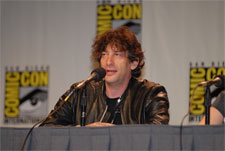
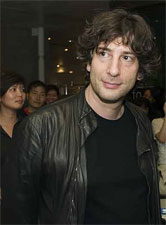
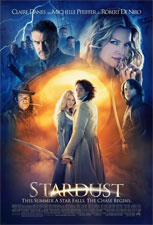
August 6, 2007 For author Neil Gaiman, seeing his expansive graphic novel "Stardust" made into a film that is getting the full-press treatment is a triumph in and of itself--though he initially approached the whole experience with anxiety if not dread. No wonder he felt this way for the comic book creator and text novelist has had his projects go awry in the past (witness the TV adaptation of "Neverwhere"), enough so that he has become both producer of films such as "Stardust," but also a screenwriter and director as well. The English-born 46-year old father of three first established his reputation and fan base by helping to revamp the concept of graphic novel with a strong sense of the mythic and vision of a personal mythology. That and a strong sense of humor helped make such series as "Sandman," "The Books of Magic," and "Stardust" such seminal texts for graphic story fans. The Minneapolis-based Gaiman has also written sci-fi inspired novels such as "American Gods" and "Anansi Boys," voiced audiobooks, and even relaunched other great comics such as the late Jack Kirby's series "The Eternals" for Marvel Comics, winning various awards in the comic and sci-fi fields along the way. Now "Stardust"--the grand coming-of-age story of a teenager, Tristan (Charlie Cox) who tries to win the cold-hearted Victoria (Sienna Miler) by bringing her a star (played by Claire Danes) that falls in the land of Stormhold--offers a broad tapestry that should attract alot more than Gaiman's cult fandom.
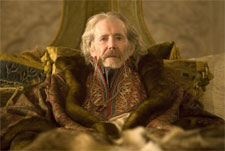
Neil Gaiman: "Stardust," for me, is about a boy becoming a man, and it's about that classic fairy-tale thing of setting out to find something, to prove yourself. But it's also about that life thing—discovering that the thing you set out to find is very often not the thing you thought you were going to find. Going out on an adventure, whether in life or in fiction, changes you, and that for me was always the heart of "Stardust" when I was writing it. I wanted to write a story about a young man who sets out to find his heart's desire, and [finds] it wasn't what he thought it was. And what we've done with the film is compressed [the story] and squeezed it, we've occasionally done filmic versions of things I'd done in the book, and we changed the ending, which is something I knew we would have to do when I sold it to Miramax back in 1999. As an author, I loved writing the end of the original novel because it's enormously fun, its filled with lots of people missing each other and things that never hit in the way you expected them to. And it's enormous fun for a reader, who is seeing everything from above and knows more about everything that's been happening than the characters do. But I realized even then it could be incredibly frustrating to have that ending happen if you were a viewer of a film, because you'll be sitting there and expect all these characters to meet at the end and then they all miss each other and you go, "WHAT?! What the fuck was that about?!" In making this transition to the film, have you been able to maintain a degree of control or input, or at one point do you relinquish that and get to see what they do? NG: Unless you're actually both directing and completely funding the film that you're making, you will have to relinquish control. But what I tried to do with "Stardust" was figure out a way that would allow me to get a film that I was happy with made. Having gone through various incarnations of the Hollywood experience now, I've sort of learned things you don't do. "Stardust" itself was first bought for the movies by Miramax in about 1998, '99, and went through an unsatisfactory development period, and eventually I got the rights back and just went, "I'm never going to do that again." And so for the following several years, people come to me and said, "We want to do a 'Stardust' film," and it would be directors or it would be beautiful young actresses who viewed it as a staring vehicle for themselves, and I would simply say no, driving my poor agent mad. And I continued to say no until I started talking with [producer, director and co-screenwriter] Matthew Vaughn about it. I'd already worked with Matthew on one project [in which] we reached a point, very briefly, where we had a small impasse where his producers wanted him to do one thing but we'd agreed to another--it was just a handshake deal--and for abo But in Matthew's case he was completely trustworthy, and that already had me interested. We talked briefly, he and I, with Terry Gilliam about doing "Stardust," and Terry had just come off "The Brothers Grimm" (2005) and wasn't going to go back to fairy tales for all the tea in China. And then the next thing I knew, Matthew, completely unplanned, ended up directing "Layer Cake" (2004) and then went off to do "X-Men: The Last Stand" (2006), and walked off "X-Men," went back to England, and I got a phone call from him saying, "I want to do 'Stardust, what do you say? We'll do it together." And I thought about it for all of about 30 seconds and I said yes, OK. I went out and found him a screenwriter [since] I knew I didn't want to write it myself, and also knew I wanted a screenwriter who I could trust to get the material and who would complement Matthew. Matthew is very upfront about the fact that he is pretty much a sort of boys' director, and what he loves and understands is the action stuff and the bouncing around, and--I think he's better now--but definitely going in on this he was much less comfortable with things like human relationships and love and all that kind of stuff. So I wanted to find somebody who really did have that, and that was Jane [Goldman]. After that my role mostly consisted of reading drafts and saying, "I wouldn't do that if I were you." At one point in November, two years ago, I flew over when we had a draft that was pretty much a shooting script, and Jane and Matthew and I sat in Matthew's study and Jane and I read the script out loud, trying to do it in a world in which I took males parts and she took female parts. But it didn't always work like that, and that was really educational because at that point there were a lot of places were I said, "You really don't want to do this because…" or, "Have you thought about doing this?" And some of the things I wanted him to change I was wrong about, and there were battles that he won because he was the director--which was absolutely the way they should be; it's his film. But at the end of the day I was incredibly glad with the film that we made. There were things that weren't there because the budget wasn't with us, but pretty much it's the film that we both agreed needed to be made. I did the [audiobook] for "Stardust" a couple years ago, and one of the things I learned doing that, that if you read "Stardust" out loud it's 10 ½ hours long, so immediately you get to the point of, "How can I compress this?" If you made the film, not only would it be 10 ½ hours long, but the hero wouldn't be born till a half-hour in--so how do we get him born pre-credits. Did you ever think you'd get actors like Robert De Niro or Michelle Pfeiffer as part of the cast, and did you have anybody in mind to play those roles? NG: Was I surprised? Absolutely, gob-smacked. I think the last couple years the casting fairy definitely has been with me, both with [Stardust] and "Beowulf" [currently in post-production and for which he co-wrote screenplay] but with "Beowulf" it even got weirder because I just remember sitting there with [executive producer and co-screenwriter] Roger Avary and [director] Bob Zemeckis making up our dream cast in March, and then the following November they were all there, and we're going, "This is really, really weird." But no, with people like Michelle Pfeiffer [who plays the witch Lamia in "Stardust"] you don't sit there going, "We will get Michelle Pfeiffer to play the Witch," you sit there going, "We will get someone cool and scary and witchy to play the witch, I wonder who it will be?" And to be honest, I was just as happy with the unknowns; there is some lovely, wonderful casting in there. Charlie Cox [who plays the lead role of Tristan] is absolutely unknown, but he's one of my favorite things in there--watching him go from awkward, nerdy boy to confident hero. He does it so well, you almost forget how amazingly nerdy and irritating he is in the beginning. For me, it's all about the performances--I didn't sit there going, "Oh my gosh! We got De Niro!" Even when we got De Niro I asked how is this going to work--is this going to be good and I was relieved when it was. Is there any downside for you in seeing your creations onscreen? NG: Yeah, if its bad, it can be really bad, you know. Over 10 years ago I [wrote the original miniseries script] "Neverwhere" (1996) for the BBC, and [it] was sort of mocked up by the BBC in every possible way, from costume, to cast, to the way it was shot, to, y'know, everything. And that actually wound up producing the novel for me, because I was so irritated with the TV series, it was like, "No! That's not what I meant," and I went off and wrote the novel. With "Stardust," I remember I was holding my breath, and I didn't know I was holding my breathe until about two weeks before they finished shooting, and Charles Vess [the artist of original graphic novel] and I went over to the set. I'd been there until they started shooting and then I had to go off to Australia and I just wound up with a full calendar and so I missed De Niro, I missed a lot of his stuff, and now I was flying in and they had about half an hour of raw footage for Charles and me to see. I was terrified and I didn't know how terrified I was until I saw it and loved it and breathed out this huge sigh of relief and said, "OK, it's my thing, it's lovely." It's very, very weird being the author of the book anyway, because, really, what you want for a film is for everyone to see it, you want everyone to love it, you want people to tell their friends, to go back again and come up to you on the street and say, "By the way I saw your film, "Stardust," and loved it and it was so moving and Michelle was so scary and De Niro was so funny and, oh my gosh, Charlie Cox, I loved it and I'm going to see it again and buy the DVD--but the book was better." And that's really what you want. Now that you're going to become a director, you really can't say that. NG: Oh, I can always say that! But you know, books and films are so different. Films occur in real time, they are one experience, they take two hours to happen and they play out and you see things and learn things. With a book, you have this peculiar experience in the back of somebody's head. You know, you've written something, but you've only used words and now they are making their own film [in their head], and if it's good, it's better than anything you could ever make. I love directing stuff and making films, I love that process, and as a writer and producer as well—it's magic—but for me books are kind of perfect because they involve no compromises at all. In "Stardust," there really weren't a lot of compromises, but, for example, in a place where, a week before we started shooting, we had to grit our teeth and go, "OK, we got the lion and the unicorn having a battle in here, and Tristan saves the unicorn and that is how the unicorn comes into the plot and it's going to cost us $1.9 million and will last roughly 90 seconds and we don't have that money to spend at that point--what are we going to do?" And suddenly the unicorn wanders into the story [instead]. Every time I see that unicorn I think if we only had [an additional] 1.9 million dollars. Page 1 | Page 2
|
| (August: Main Page * Features * Reviews * Screenings * Teen ) Current Issue * Archive |
 |
|
Terms of Use
| Privacy
Policy Copyright © 1999-2007, BlackFilm.com
|
 STARDUST