
April 2003
Love & Diane
|
April 2003
Love & Diane
|
| (Apr: Main Page * Features * Reviews * Screenings * Teen ) Current Issue * Archive |
|
Reviewed by Niija Kuykendall
Love & Diane is a combustable cinematic experience of simultaneous pain
and hope, fear and faith. Jennifer Dworkin’s brilliant documentary is
the story of three generations worth of survival in the face of numerous
social obstacles that keep the underpriveledged locked in an oppressive
socio-economic cycle of struggle. In this work the viewer is allowed a
close look at the dramatic lives of Diane Hazzard, a publically assisted,
The film immediately grabs us with Diane’s brave attempts to pull her family
together after her children return home from a traumatic 6 year odyssey
of foster and group homes, a result of Diane’s drug addiction and charges
of neglect. We follow the family through a two and a half year fragment
of their trials and joys all the while observing, learning, viscerally
experiencing the pain of the past and love of the present within the intricacies
of Love & Diane’s relationship to each other and that relationship’s dynamic
within a claustrophobically oppressive context. We are with the two women
as What is the most amazing aspect of this work is its incarnation as a space for the subjects’ own political agency, self-exploration and healing. By gifting the family with a means of agency and autonomy in the form of cameras, Dworkin essentially gives the family the rare opportunity/tool of narrative power. Love and Diane tell their own story in their own way as it unfolds with a conclusion of their own making. Empowerment for these women is in the ability to re-present themselves (versus the presentation of them that has already been constructed by a hostile society), or at least to guide the filmmaker in an accurate-as-possible presentation of their lives, loves and loss. Amid this road to empowerment and life for the subjects and filmmaker, we as viewers are helplessly caught up in reflections of ourselves. The Hazzard family becomes our family and the film leaves us both relieved yet wanting more, always thinking, analyzing and wondering how our family is doing.
Description: Jennifer Dworkin’s brilliant documentary is the story of three generations worth of survival in the face of numerous social obstacles that keep the underpriveledged locked in an oppressive socio-economic cycle of struggle. |
|||||||||||||||
| (Apr: Main Page * Features * Reviews * Screenings * Teen ) Current Issue * Archive |

 former
crack-addict mother of six, and her daughter Love Hinson, 18 year-old,
HIV + mother of new born Donyaeh. It is easy to disengage one’s self and
list aspects of these women’s lives like a fixated checklist of disastrous
characteristics before we are snatched from our comfortable worlds of
voyeurism and thrust into their compelling narrative of life. As we watch
the film we are truly allowed an inside view into what it means and feels
to be Love and Diane, African American women negated and positioned on
the outskirts of society, and it is the honesty and poignancy of Love
and Diane‘s autobiographical narrative that forces us to care.
former
crack-addict mother of six, and her daughter Love Hinson, 18 year-old,
HIV + mother of new born Donyaeh. It is easy to disengage one’s self and
list aspects of these women’s lives like a fixated checklist of disastrous
characteristics before we are snatched from our comfortable worlds of
voyeurism and thrust into their compelling narrative of life. As we watch
the film we are truly allowed an inside view into what it means and feels
to be Love and Diane, African American women negated and positioned on
the outskirts of society, and it is the honesty and poignancy of Love
and Diane‘s autobiographical narrative that forces us to care.
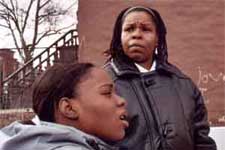 they
struggle to keep their family together in the craziness of a welfare and
social system maze that should help but only destructs. With a sharp intensity,
the work’s emotional fabric slowly entices the viewer tocomplete fascination,
submission and empathy with its subjects.
they
struggle to keep their family together in the craziness of a welfare and
social system maze that should help but only destructs. With a sharp intensity,
the work’s emotional fabric slowly entices the viewer tocomplete fascination,
submission and empathy with its subjects.