|
About | Features | Reviews | Community | Screenings | Archives | Home |

March 2008
FUNNY GAMES
An Interview with Michael Pitt and Brady Corbet |
| (March: Main Page * Features * Reviews * Screenings * Teen ) Current Issue * Archive |
|
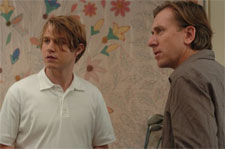
Michael Pitt and Brady Corbet Aren't Joking Around in Funny Games Ten years ago, German director Michael Haneke created a near-psychotic, harrowing and disturbing film,"Funny Games," about two young men, Paul and Peter, who force a mother, father, and son in their vacation cabin to play sadistic "games" with fatal results. Both a critique of our society's fascination with violence and a dire warning about how thin is civilization's veneer both for victims and their tormentor Haneke's film stirred both admiration and revulsion for unseen violence and depravity. Given Haneke's cultural origins, his film had a resonance that extended its impact well beyond its decade-old release. In the recent shot for shot English-language remake of "Funny Games," Haneke found in actors Michael Pitt and Brady Corbet two individuals who express both a beguiling quality aligned with a sociopathic unpredictability that leads them to perform far more torturous scenes with showing much blood and gore in comparison to such torture porn films as "Hostel" and "Saw." Yet this film not only fits the genre of "sadistic men who torture a family in suburbia" but also deconstructs the In their short careers, both Pitt and Corbet have already established themselves as veteran actors who have worked with an impressive list of directors. The 26 year-old Pitt got his break in Bernardo Bertolucci's "The Dreamers" and is known for his Kurt Cobain-like portrayal of fatalistic rocker in Gus Van Sant's "Last Days." But he foreshadowed his sadistic role in "Funny Games" with his work in "Murder by Numbers." The 19 year old Corbet, who starred in two dark films, "Thirteen" and Gregg Araki's "Mysterious Skin" provides a perfect Peter to Pitt's Paul. Q: Was director Mich MICHAEL PITT: He was difficult but he's really smart so I didn't feel that it was unjustified. I knew that going in though. That was something that with Michael, I would've been in hell if I didn't know that that was the way that he was going to work. I knew going in that it was going to be like that. I did a work session with him and I could tell that... Some directors are very free and some directors are very specific. It seemed like doing a play, [it was] that relationship with the director, when you do a play. Q: Did you see the original film before you worked on this version? MP: I saw it once. BRADY CORBET: I've seen it a few times. Q: How did you guys read your characters and prepare for them? BC: They are characters without a past or a future. They have no backstory. They are a device. At least for me, they are nothing more than a device. I think it ultimately came down to not being "true" or organic; it was more about being successfully manipulative, charming, and charismatic. Q: Was that harder for you? BC: In a controlled environment like that, it was very, very easy to be charismatic if you have the right dialogue and the right captain. It's much more difficult to be in Tim [Roth], Devon [Gearhart], and Naomi [Watts'] shoes. They were a wreck every day. Tim in particular had a pretty tough time. He has kids so he had a very rough time. MP: I didn't come up with a back story and I never analyzed why Paul was doing what he was doing. I wasn't sure I was going to do it that way and then I decided that based on what Michael Haneke was telling me that I shouldn't analyze what I was doing. In a weird way, it really freed me. Q: Did either of you see one of your characters as being the leader, in this sense maybe Paul? BC: Absolutely, it's like Laurel and Hardy. It's like Paul's in the motorcycle and Peter's in the sidecar in a way. For me, I found it very interesting. I tried to convey in a subtle way a sense of knowing. I didn't want to be a genuine goofball or clumsy but I wanted it to feel exact, like when I drop the cell phone in the sink, I know what I'm doing. Q: How would compare Haneke's direction from other directors—what element stood out for you? MP: Every director is different and they all have different styles. I've worked with directors who were very specific and their direction was very high, they gave a lot of direction. The one thing about Michael that I think is interesting is that he really has a reason for everything he's asking you. If you challenge it, he is open for discussion but he has a clear idea of what he wants with reasons why. There are directors whose direction is high but can't back up what they are asking; then when you challenge it, they crumble. They can't back up what they're asking. Q: Michael, how did he chose you for this role? MP: I wasn't looking for a project. I wasn't interested in working in film at that time, but I had a friend called Q: Did you rehearse before shooting? MP: I rehearse all the time when I get a role. Q: Brady, how did you get the role of Peter and meet Haneke? BC: I met Haneke for the first time at the Egyptian Theater in Hollywood about six years ago. When I found out he was making a film in the States—this was before he was remaking his own film—and since I was a fan of his, I made a lot of phone calls and asked to be put in a room with that guy again. I would do anything for the film. They initially didn't want to see me because I was too young and I was too skinny. MP: They were right. BC: After that I was taking bodybuilding supplements without exercising where you don't retain water, you just bloat. I wore a little fat suit underneath the shirt. I had a face to match the little pad I had. Q: How was it working with both Tim Roth and Naomi Watts? MP: I was really impressed with Naomi. She was a producer on it and she was doing things that I wasn't really aware of. The way she was able to switch in handling problems, and then also shoot a really difficult scene I think is a real testament to her true ability, and Tim helped me a lot, sometimes when I had a problem and I couldn't figure it out, he would talk to me because Tim is also a director. BC: Tim is an incredibly smart man. He's got a little pit bull in him, this Eastern London thing, but his first film which I saw again recently is amazing, "The War Zone," it's a great film. He should direct more. I think Tim and Michael Haneke had problems because Michael is intelligent but so is Tim and he had very particular ideas. MP: Tim was constantly very worried about making a film that would be perceived as just a violent film, and he was very concerned about people taking it the wrong way so I think that a lot of the battles that were happening on set were as a result of that. BC: He's a father and what was interesting about "The War Zone" is that as aggressive as it is, it's als MP: Tim definitely had the hardest role. That is by far the most difficult role to play because he's not strong and he's not attractive. As an actor, for me that would be the most challenging role and also in a way even if you succeeded, very few people would realize. Q: Since it's a shot-for-shot remake, it's like a play where you are seeing the same art form but with different performers. Do you think movies can work as plays? MP: I think it can but maybe I can't be as objective if I wasn't involved. It's interesting because if you keep it shot-by-shot then in a weird way you see what the actors bring what's different, where it was filmed differently it would be a different film. BC: It's a great cinematic experiment. MP: It's a tough movie in a sense where it's very difficult when you watch it the first time, it's very rough to watch it again. BC: It's good because we did a good job, we all worked very hard on it. MP: I hope that this will broaden Michael Haneke's audience because in America if it's not in English, there's a very select few people who watch it. BC: The themes are clearer not because it's a better film but because it's the second time around. I think that the first movie is a movie about movies, and the new film is a remake of a movie about movies, so if the first film asked the question of why are you watching this, then the new film has to ask you why are you watching this again? It's the only film of Haneke's that could be remade successfully. The original and the new film are on the nose in a way that his other films are not because it's his way of conforming to a genre in a smart way. MP: I also think it's good that Michael did it and it's not some American director doing it some other way. It's interesting that he did it. Q: Why do you think he decided to remake it? MP: I think he was approached and had this idea to make this film. What he's told me and what I sensed when I watched the original, it seemed like it was making a comment on a very American topic. That's what I felt. Then I found out that it was true and that's what he was intending. I think he's even gone as far to say that he wanted to shoot the original in English and in America, but he didn't have the money. BC: The original film has an English title. MP: He's getting to finish what he started and also I do think that he is thinking that possibly it could broaden his audience. If a young kid in America sees this film, and he likes this, I would be worried about this, but he would want to research the work of Michael Haneke, then hopefully he'll have the opportunity to see all of Michael's films. BC: It's important to point out that there was no real financial gain in this for Michael. It's a bigger film but it's a still an independent film. MP: I hope he gets some kind of gain from this. He deserves it. BC: What I mean is he doesn't have anything to prove at this point. He wanted people to see this because he felt that it was an important issue. It wasn't that he wanted more people just to see him. PAGE 1 | PAGE 2
|
| (February: Main Page * Features * Reviews * Screenings * Teen ) Current Issue * Archive |
 |
|
Terms of Use
| Privacy
Policy Copyright © 1999-2008, BlackFilm.com
|