
|
|
About | Features | Reviews | Community | Screenings | Archives | Studios | Home |

February 2006
BLACK SNAKE MOAN An Interview with Samuel L. Jackson |
| (February: Main Page * Features * Reviews * Screenings * Teen ) Current Issue * Archive |
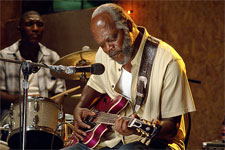
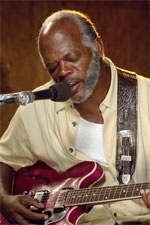
I just have to ask, did you run into any mother-fucking snakes down in the mother-fucking south? Samuel L. Jackson: Well, you know in the south there are snakes. I heard there were some around. I didn't see them. Did you know you’d had a voice for the blues? Samuel L. Jackson: No. No because you do. Samuel L. Jackson: Fortunately Mississippi delta blues doesn’t necessarily need a silky smooth Luther Vandross type of voice. It's more about making sure the emotion of what you're saying is coming out then being a great singer it helped a lot. Did you play the guitar? Samuel L. Jackson: I learned to play. It was one of the things that I spent most of the time doing. Fortunately I had maybe 6 or 7 months to work that out and had a really good guitar teacher in the beginning. Felicia Collins in NY while I was shooting Freedomland then when I left to do Snakes on A Plane in Vancouver the prop master was an awesome guitarist so he spent a lot of time with me in my trailer every day, so it was something I did daily, constantly for 6 or 7 months until I was comfortable doing it. I tactually became something I looked forward to doing every day. By the time we got to the film I was pretty fast out on it. I actually taught myself to play the songs in a very different way than Scott played them, cause I’d watched him play them and I worked it out like this and he watched me play and said I never thought of doing it that way. Then I talked to all these old blues guys when we were doing our little road tour and most of them had taught themselves to play after 30 and they all had very different playing styles so I created something that was actually my own in terms of how I learned how to play and worked my way though the songs. According to Big Jack, that's really cool. You got it. Thank you. Lazarus seems to be to me a man between two worlds because he's a guy that's certainly had his knocks and been through the times in his part of the world where a black man couldn't hold his head up the way he’s able to now. I wonder about his choice of taking in Rae rather than just getting her to a hospital and saying I don't want to have anything to do with this white woman. Samuel L. Jackson: Interestingly enough I understand the choice just because I understand the rural south because I spent a lot of time in it when I was a kid and my grandfather's brothers were farmers and I spent time on the farm when I was a The bible's there, we see it opened up but that would have added a different dimension. Samuel L. Jackson: Yes, exactly. Yeah. Speaking of the bible, how did you enjoy being the voice of God? Samuel L. Jackson: It was alright. It was fun in the moment I was doing it. It was kind of something that just happened because I went there to read something else and all of a sudden, you know, it's like you know, read some of this and I did and we read the rest of it and it just kind of went off. Is it easy to act with a beautiful woman who's almost naked and has a big chain on her? Did it add a different dimension? Samuel L. Jackson: Well you know after about I guess an hour of looking at Christina in those little panties and that shirt you kind of get over it because that's what she had on every day and she didn't put on a robe between shots and hide herself. She just kind of hung out, so you get over it pretty quickly. The great thing was that during the rehearsal period, Christina and I developed this really interesting bond and interesting trust that kind of allowed her to kind of go anywhere she wanted to and I'd support her to the point where as an actor or as Samuel L. Jackson I became another sort of Lazarus figure in terms of...writers and directors write things and then when they see it on its feet it takes on a What made you fall in love with this particular character? Samuel L. Jackson: Well, the complexity of who he is and like I said he seems to be an amalgam of my grandfather and his brother’s. The guys that I worked with in the fields and talked to and people of the earth who drank hard when it was time to drink and they loved the blues and they sang and told stories and they did all this stuff. It's just an interesting way for me to pay homage to some men that developed me in that particular way that made me want to be a storyteller. What can you tell us about Justin Timberlake? Was he a better actor than what you were expecting? Samuel L. Jackson: That's loaded. The interesting thing to me about Justin is it would have been easy for him to choose something that allowed him to be more Justin Timberlake because guys, especially young guys, don't tend to want to portray people who have frailties and are less than macho. It's an interesting choice for him to choose a character that's so opposite of who most women or guys would want their heroes to be. He wasn't afraid to do it. He stepped in there and gave it his best shot. It worked for me in the film. You're doing the voice of Afro-Samurai. Is that a similar process to The Incredibles? Samuel L. Jackson: Yeah, you just go into the studio and kind of read the stuff and kind of do it and do it in different spaces in time. All of a sudden somebody will call and it's like we need you to come to the studio and do som Do you see a lot of yourself in Afro-Samurai? Samuel L. Jackson: I see more of myself in Ninja Ninja apparently. That’s the most talkative voice. You shot The Cleaner in Shreveport is that right? Samuel L. Jackson: Still shooting the Cleaner. I'm going back tonight. The portraits of the south that we're getting in films today and Black Snake Moan is part of that...we're seeing a difference. We have this stereotype that it was reinforced by the films of the last let's say 20 years, do you think it's getting a fairer shake when you there? Are people more comfortable with the idea that you're going to portray them well? Samuel L. Jackson: Actually, The Cleaner is set in New Jersey, so they're making an effort to shoot things that look more Jersey like than southern. So is New Jersey getting a fair shake then? I guess that's the movie illusion but people are comfortable with....? Samuel L. Jackson: They're just glad there are a lot of people working. There are about 5 films shooting in Shreveport right now. It's a very busy time in the town and about 4 or 5 more coming in next month. So apparently the incentives that Louisiana is giving the film companies and the right to work state and not having to worry about unions in that particular way is very appealing to a lot of people. What did Craig tell you about this character and then what did you tell him about this character? Samuel L. Jackson: Craig didn't tell me anything about the guy actually. Once I got the script and I read it and then they went through all the machinations of that's not who you're supposed send the script to and "ok I'll go meet him and what Some actors say that a role scares them or a part scares them initially that they know it's right. Do you go through that process or are you beyond that? Samuel L. Jackson: Fear? No, I'm always anxious to jump in there and kind of figure out who a person is, where they're coming from and what they're doing. Its part of the challenge and part of the I guess fascination of exploring the human condition for me to be able to safely walk into spaces that are dangerous and know it's a controlled environment and not have to worry about being damaged by it in the end. But finding or looking back and saying have I seen anybody like that? Have I talked to anybody like this? What was their process or how did I perceive their process to be because it's all make believe. You make up anything you can to make the character fuller for me. Lazarus had a lot of stuff going on. He led a pretty wild life and gave that life up when he got married and became this farmer which was not what that woman married. She married somebody who had a high-life, who's kind of lively and he bored her and she left and he had no understanding of that whatsoever because he viewed himself as a great provider, kept the house warm and kept you fed but she needed more. He had no conception of that and didn’t understand that his music was what made him a person who was alive in a real sense and once he got back to it he got back to what made him feel better about himself.
Page 1 | Page 2
|
| (February: Main Page * Features * Reviews * Screenings * Teen ) Current Issue * Archive |
 |
|
Terms of Use
| Privacy
Policy Copyright © 1999-2006, BlackFilm.com
|
 BLACK SNAKE MOAN
An Interview with Samuel L. Jackson
BLACK SNAKE MOAN
An Interview with Samuel L. Jackson 
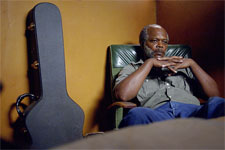 kid with them walking through the fields and working and hanging out. But there are instances where you find yourself in a circumstance if you put her in your truck and take her to the hospital there a lot more questions than if you keep her at your house and try to nurse her back to health and hopefully she'll walk away. That choice that he made of keeping her there very kind of ....sort of out of his mind in another kind of way at that point. He'd lost his woman that he had no control over and all of a sudden he has a woman and she's kind of out of control in that interesting sort of immoral way he pictured his wife and he wanted to control her and fix her in another way. The only way he could think to do that was to put this chain on her and still give her some amount of freedom and kind of pump this biblical medicine into her. It's interesting it's not in the film but we shot a lot of stuff where he's reading the bible to her at different times, like when he puts her in the tub for the first time, he's sitting there on the floor and starts to read to her. She's in the tub and then there's times when she's laying on the sofa and he's reading to her and then there are times when she's eating and he's reading to her, but all that stuff is gone for some reason but the time frame seems kind of off. I don't know how you see it but in our cinematic minds when we shot it she was at his house for over a month, now it looks like she's there a couple of days.
 whole other life and then when they see how far 2 people who put life in it can go, all of a sudden they go, "Oh my God, I didn't realize it was that. Well let’s try this and you have to go, no we don't have to try that because we're already in this place and if you do that then you go too far. Plus there are things in here that are hard and have sharp edges and Christina just kind of goes. If you do that then she's going to break her toe or something's going to fall and you're going to hit her in the head and then we wont' be able to work so let's not do that.
 e more stuff so you do it. Fortunately that project lent itself to me having 2 different voices and being a producer and doing all this other stuff and I guess it's been relatively successful because they've ordered another season, so hopefully we'll get it done.
 ever. Craig saw me on television talking about my life and decided he's got enough layers in his life to be able to play this guy. I'm an actor who shows up to rehearsal with a lot of stuff. I sit down and work out things about characters and put together biographies and histories and all kinds of stuff so by the time we got there and started the rehearsal period it was very smart of him to just sit and watch me and Christina just kind of go though what we were going through and figure out how our relationship worked and what two people would have no idea of what kind of people they've encountered. She's never met anybody like me that she couldn't sexually manipulate and I've never met anybody or understood what a sexual dysfunction like that was. I guess a country guy who's a farmer who was playing the blues for a while or been in clubs you've probably ran into some pretty wild women in his day but when people talk about nymphomania, I mean people talk about it but how many people know that they're actually run into a real nymphomaniac or a sexual dysfunctional person. You don't know how to handle it or exactly what it is. To him she was just somebody who was possessed by the devil or evil. The only thing he knew to do is exorcise it.