|
Highlights of the Human Rights Watch International
Film Festival

From June 13 through June 26 the Film Society of Lincoln Center
in New York City hosts the 14th Annual Human Rights Watch
International Film Festival. This compilation of 28 shorts,
features, narratives and documentaries all focused on the critical,
and in most cases contemporary, examination of human rights issues
around the world that will leave viewers breathless and, more
importantly, aware. With selections addressing issues from the
Palestinian-Israel conflict to the HIV/AIDS epidemic in South
Africa, the festival exhibits a much-needed localized perspective
on major human rights issues from every corner of the world.
Madame Sata
One of the most breathtaking of these films is Madame Sata,
a Brazilian offering from writer/director Karim Ainouz. The historical
narrative is based on true events and explores the life of Madame
Sata, or Joao Francisco, an almost mythical chameleon in the bohemian
district of Lapa, Rio de Janeiro who forged his fame fulfilling
his dream as a flamboyant stage performer, all the while never
shedding his claims to the streets. Francisco died in 1976 after
leading a dramatic life in and out of notoriety and jail. Ainouz’s
work tells the story of Francisco, pre-Madame Sata, as he continuously
throws a wrench in the societal wheels by redefining his identity
again and again while trying to transcend the stigmatizations
of class, race and homophobicism. The narrative follows the daily
life and dramas of Francisco as a violent yet caring enigma and
ends on the brink of Francisco’s transformation into Madame
Sata. The most amazing aspect of the film is Walter Carvalho’s
work as Director of Photography and Marcos Pedroso’s production
design. The imagery of the film is dark, itimate and rich. What
you see on film brings to mind the stench you would actually smell
in the run-down neighborhood in which Francisco’s makeshift “family”
lives in the 1930’s. The pain of Francisco’s unrealized dreams
we can see in the colors and textures on screen. Opening July
9 at the Film Forum in New York, the work is one of beauty and
complexity addressing one man’s ability to invent himself and
live free in an imprisoning world.
|


|
|
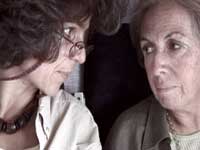
Wartakes
Wartakes is a standout work from award-winning filmmakers
Adelaida Trujillo and Patricia Castanao of Bogota, Colombia. Not
an ordinary documentary, the film is an intimate, personal diary
of the filmmakers’ lives in the violent conflicts of Colombia.
The work is so fascinating to watch not only because it brings
awareness and clarity to the political and social issues of Colombia’s
long-running conflicts but it also allows outsiders a daily, inside
view at real middle class living and thought within the conflict.
The filmmakers must also deal with the dynamics and consequences
of turning cameras on themselves and their families in such trying,
heart-breaking times.
|

|
|
When the War is Over
While Wartakes addresses a war in process, South Africa’s
entry When The War Is Over, takes a critical look at the
affects of war on two former guerrilla freedom fighter comrades
in post-apartheid South Africa. Gori and Marlone are survivors
of the Bonteheuwel Military Wing (BMW), a teenage self-defense
unit of the 1980s and carry many scars and reminders of the violent
Apartheid era. While Gori tries to build a life with a new family
and as an army captain in the new South African army, Marlon is
now a gang member and his efforts to leave the violent world by
initiating peace talks are tested by his sister’s murder by a
rival gang. Although hope permeates scenes of family life and
peace talks, the harshly realistic film takes viewers through
a world where ex-activists are socially and psychologically scarred
from post-Apartheid disappointments in a new South Africa.
|


|
| |
|
Balseros
Balseros by Carlos Bosch, is a feature length documentary
following seven Cuban balseros (rafters) who flee Cuba for the
U.S. in homemade rafts during the Cuban exodus of the summer of
1994. The film offers intimate portraits of each Cuban protagonist,
beginning with the time spent with their families a few days before
their departure to seven years after their arrival in the U.S.
The film is an examination of the complexities of immigrant/exile
life in the U.S. as well as the dynamics of cross-national, cultural
familial relationships.
|


|
| |
|
Asylum
Asylum is a short film by Sandy McLeod telling the story of a
Ghanaian woman who flees to the U.S. when her father decides she
must undergo the female circumcision process customary to his
tribe then marry an old man of his choice. The film is a personal
account from Baaba Andoh herself within a powerful collage of
imagery representing Baaba’s Ghanaian childhood and flight of
terror.
|
 |
These are just a few of the powerful snapshots of humanity and activism
exhibited at this year’s Human Rights Watch International Film Festival.
Each piece will definitely speak to all and I encourage you to check out
what you can.
For a schedule of the films, click
here.
|