|
Blackfilm.com would like for you to Support the
10th African Film Festival in New York City
There are a lot of African American Film Festivals that go on
throughout the years such as the Urbanworld Film Festival, and the
Hollywood Black Film Festival. While they showcase a number of
African-American films, sometimes the ones that get overlooked are
the foreign films. These films always carry strong messages as they
show what life is like outside the USA. The best of recent and
classic African cinema will be shown at the Walter Reade Theater of
Lincoln Center from April 5-10, and will continue with programs at
the Musuem for African Art on April 11 and the Brooklyn Museum of
Art on April 18 and 19. Selected highlights include a panel
discussion involving Zimbabwe filmmakers and Digital Africa, which
presents digital video works on life throughout Africa. Many
filmmakers will be available to talk about their films. Here are
some selected films that are worth seeing:
|
Waiting for Happiness
|
 |
| Director/Writer: |
Abderrahmane Sissako |
| Cinematography: |
Jacques Besse |
| Producer: |
Guillaume de Seille |
| Cast: |
Mohamed Mahmoud Ould Mohamed, Khatra Ould Abdel Kader, Maata Ould
Mohamed Abeid, Nana Diakite, Fatimetou Mint Ahmeda, Makanfing Dabo,
Nema Mint Choueikh
|
| Reviewed by: |
Niija Kuykendall |
|
Starting Saturday, April 5 in New York City at the Walter Reade
Theatre in Lincoln Center, the 10th Annual New York African Film
Festival is sure to be full of hauntingly beautiful, layered interpretations
of the many complexities of life that make up a modern, diverse
Africa. A highlight of the fest will be the mid-career retrospective
of the prolific Abderrahmane Sissako, the globally oriented auteur
of Mauritanian birth.  Sissako’s
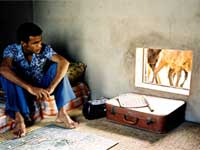
most recent work, “Waiting For Happiness”, will kick off the festival
with a look at the daily life of West African seaside port Nouadhibou.
A transit city by logistical definition but a home for its permanent
denizens, Nouadhibou and its inhabitants are an example of the serene
state of limbo. In between destinations, in between generations,
in between societies, the protagonist is a young man on his way
to Europe. As he visits his mother before departing we observe the
life of a city that is in a constant state of waiting with a plethora
of contradictions pulsing beneath the stillness. The city and its
people, permanent or not, are constantly stationary yet nomadic,
peaceful yet tumultuous in their quests for a happy life. For some
that dream is elsewhere, signified by the many instruments of displacement
and signs of the outside world that pass through and by the city.
Others are seemingly content in their inescapable environment as
these transient vehicles and wanderers pass them by. The viewer
is instantly drawn into the beautifully composed and scored work,
content to be fascinated by the surprising little dramas of life
in a world of isolation and hope. Sissako’s
most recent work, “Waiting For Happiness”, will kick off the festival
with a look at the daily life of West African seaside port Nouadhibou.
A transit city by logistical definition but a home for its permanent
denizens, Nouadhibou and its inhabitants are an example of the serene
state of limbo. In between destinations, in between generations,
in between societies, the protagonist is a young man on his way
to Europe. As he visits his mother before departing we observe the
life of a city that is in a constant state of waiting with a plethora
of contradictions pulsing beneath the stillness. The city and its
people, permanent or not, are constantly stationary yet nomadic,
peaceful yet tumultuous in their quests for a happy life. For some
that dream is elsewhere, signified by the many instruments of displacement
and signs of the outside world that pass through and by the city.
Others are seemingly content in their inescapable environment as
these transient vehicles and wanderers pass them by. The viewer
is instantly drawn into the beautifully composed and scored work,
content to be fascinated by the surprising little dramas of life
in a world of isolation and hope.
|
|
Christmas With Granny (26 min)
An Old Wife’s Tale (26 min)
Wa ‘n Wina (52 min)
|
 |
| Director: |
Dumisani Phakathi |
| Reviewed By: |
Wilson Morales |
|
Dumisani Phakathi is one of two directors at the festival to have
more than one film showing. In “An Old Wife’s Tale”, Phakathi’s
first film, Hendrik, an Afrikaner, decides to exercise his constitutional
rights and enter into a polygamous marriage, like his Xhosa farmhand,
Lucas. He’s totally surprise when his wife thinks it’s a good idea
and good for their relationship. In “Christmas With Granny”, Madlozi
goes with his  grandmother
to be baptized in her faith, like all his relatives. While riding
a train and mixing with White South Africans, Madlozi sees that
his grandmother may be living in the past, which doesn’t look good
for his future. And in “Wa ‘n Wina”, the filmmaker returns to his
neighborhood in Soweto and engages with friends to discuss relationships,
sex, and love. Much of his discussion with them focuses on the issues
of HIV/ AIDS. While all three films are different, the common theme
among them is survival, through marriage, love, and religion. While
the films may be short in length, it doesn’t take much to get the
point across to the viewer. Phakathi has a vision he wants to the
world to see and that is showing us that in several places in Africa,
people survive on their beliefs whether they’re educated on them
or not. grandmother
to be baptized in her faith, like all his relatives. While riding
a train and mixing with White South Africans, Madlozi sees that
his grandmother may be living in the past, which doesn’t look good
for his future. And in “Wa ‘n Wina”, the filmmaker returns to his
neighborhood in Soweto and engages with friends to discuss relationships,
sex, and love. Much of his discussion with them focuses on the issues
of HIV/ AIDS. While all three films are different, the common theme
among them is survival, through marriage, love, and religion. While
the films may be short in length, it doesn’t take much to get the
point across to the viewer. Phakathi has a vision he wants to the
world to see and that is showing us that in several places in Africa,
people survive on their beliefs whether they’re educated on them
or not.
|
Abouna
|
 |
| Directed by: |
Mahamat- Saleh Haroun |
| Reviewed by: |
Wilson Morales |
|
When 15 year old Tahir and his 8 year old brother Amine wake up
to find their father missing, their mother informs them that he
has left them for parts unknown. Dazed and confused, the boys go
looking for him everywhere in the city, but have no such luck. While
skipping school and going to the movie theater, they think their
father is on the big screen and in a movie. Needing further evidence,
they steal the reel looking for clues. When caught, their mother
sends them to a “reform” school, where life isn’t the same again.
Haroun has directed a powerful film that examines the effects of
parental abandonment. It’s funny, sad, and uplifting in many ways.
Nothing is superficial as the two boys give in great performances
considering this is the first film for both of them.
|
FOR FURTHER INFORMATION ON FILM SCREENINGS
AND PROGRAMS, GO TO http://filmlinc.com/wrt/programs/4-2003/africa.htm
and http://www.africanfilmny.org
|