
November 2002
Far From Heaven
|
November 2002
Far From Heaven
| ||
| (Nov: Main Page * Features * Reviews * Gallery * Teen Current Issue * Archive |
|
Reviewed by Wilson Morales
The 1950s were an era where racism still existed in the communities of
some states. Women especially had it hard on them. Not only were they
supposed to keep their family together by being quiet and tending to the
kids, they couldn’t afford to be scandalized by gossip. In FAR FROM HEAVEN,
Todd Haynes’s film pays tribute to Douglas Sirk’s ALL THAT HEAVENS ALLOWS,
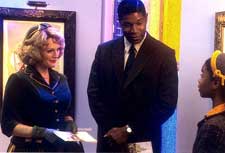
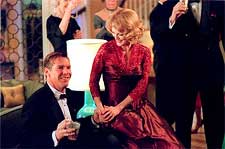
while adding the racial Julianne Moore plays Cathy, mother of two and wife to TV salesman Frank
(Dennis Quaid). They seem to be the perfect couple in their suburbia neighborhood.
They host dinners, and everyone knows them. Cathy’s few flaws, according
to some, is that she’s too friendly with the Negroes and Jews. Cathy pays
no mind to that sort of talk, so long as Frank is there to protect her.
When visiting Frank at his office one evening to leave off some dinner,
Cathy is startled to what she sees. She now has to protect her family
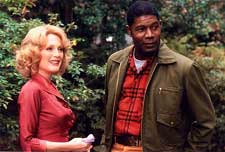
from falling apart. While she seeks help for Frank, she’s befriended by
her well-educated gardener Raymond (Dennis Haysbert). Single with a young
daughter, Raymond is a kind man who wants to be Kathy’s friend. While
Frank is trying to recover from his “illness”, Cathy and Raymond’s friendship
deepens. When a few people get wind of their “relationship”, Cathy is
now looked upon as an outsider amongst her so-called friends. It will
take her a great deal of strength to sacrifice true happiness and do the
“right” thing for her well-being Julianne Moore plays Cathy with a captivating appeal. As her naïve persona decreases and a sense of reality starts staring her in the face, Moore’s facial expression makes the difference. Her scenes with Dennis Quaid show great chemistry. Quaid, who’s had a good year so far with his role in “The Rookie”, excels as the husband who has problems. Haysbert, currently the reigning black President on TV’s 24, is very good as the gardener who stands up for his belief regardless if he’s in the minority group who share the same views. Elmer Berstein’s score is very emotional, especially when capturing the tones of each character. There are a number of issues raised in this film that a few people may recall, and Haynes was able to reinvigorate those feelings thorough the characters. While the ending is left up in the air, the film is a throwback to history. Change is important, and this film shows how hard it was back then. | ||||||||||||||||||
| (Nov: Main Page * Features * Reviews * Gallery * Teen ) Current Issue * Archive |
 issues
to build awareness as to how things were back then. Everything from the
acting, to the costume, to the set designs and even the music fit accordingly
to the 1950s. The film is a good reminder as to how things have changed
since the 1950s when ignorance was bliss.
issues
to build awareness as to how things were back then. Everything from the
acting, to the costume, to the set designs and even the music fit accordingly
to the 1950s. The film is a good reminder as to how things have changed
since the 1950s when ignorance was bliss.
 and
her family’s.
and
her family’s.